


Buildings form a crucial part of a nation’s infrastructure, supporting residential, commercial, and industrial activities. However, a significant portion of existing buildings were constructed under outdated design standards, using aging materials, or without proper consideration of natural hazards. As these structures deteriorate over time, the need for building retrofitting becomes essential to ensure safety, sustainability, and resilience.
1. Safety and Structural Stability
Many older buildings were not designed to withstand modern loads, seismic forces, or extreme environmental conditions. Retrofitting enhances the structural capacity of these buildings, reducing the risk of collapse during earthquakes, storms, or other disasters. This is particularly important in regions prone to seismic activity, where retrofitting can save lives and prevent large-scale destruction.
2. Extending Building Lifespan
Rather than demolishing and reconstructing, retrofitting extends the usable life of existing buildings. By reinforcing structural components, replacing deteriorated materials, and upgrading building systems, retrofitting provides a cost-effective way to maintain functionality while avoiding the environmental and economic costs of new construction.
3. Compliance with Updated Codes and Standards
Building regulations evolve over time to reflect new knowledge, technologies, and safety requirements. Retrofitting ensures that existing buildings comply with current building codes, fire safety norms, accessibility standards, and environmental regulations. This is especially important for public buildings, schools, hospitals, and workplaces.
4. Economic Benefits
Retrofitting is often more economical than reconstruction. It preserves the value of existing structures, enhances property value, reduces maintenance costs, and allows buildings to continue operating during improvements. Governments and organizations may also offer incentives for retrofitting, further lowering financial barriers.
Conclusion
Building retrofitting is an essential strategy for enhancing the safety, performance, and sustainability of existing structures. It supports disaster risk reduction, reduces environmental impact, and preserves cultural heritage, all while offering significant economic advantages. As urban populations grow and environmental challenges intensify, retrofitting will play a critical role in creating resilient and future-ready cities.
Expert-Quality Retrofitting Company – Company Overview
An expert-quality retrofitting company is defined by its ability to enhance and modernize existing structures with precision, safety, and long-term performance in mind. Combining advanced engineering techniques with deep industry experience, these companies provide solutions that extend the lifespan, functionality, and sustainability of buildings while ensuring full compliance with modern codes and standards.
Who We Are
We are a specialized retrofitting company committed to delivering high-quality structural and building upgrades for residential, commercial, and industrial clients. With a team of seasoned engineers, certified technicians, and project managers, we focus on strengthening and modernizing older structures to meet today’s demanding safety, performance, and environmental requirements.
Our Expertise
Our core expertise spans across multiple retrofitting disciplines, including:
1. Structural Retrofitting
• Seismic strengthening of buildings
• Foundation repair and stabilization
• Load-bearing enhancements
• Structural steel reinforcement
• Concrete restoration and fiber-reinforced polymer (FRP) applications
2. Compliance and Regulatory Upgrades
• Bringing structures in line with current building codes
Why Clients Trust Us
• Technical Expertise: Our team brings decades of engineering and construction experience.
• Quality Assurance: Every project undergoes rigorous planning, inspection, and testing to guarantee long-term performance.
• Cutting-Edge Technology: We use advanced diagnostic tools, 3D modeling, and materials that deliver superior durability.
• Customized Solutions: No two buildings are the same; our retrofitting strategies are tailored to each client’s needs and budget.
• Safety First: Our operations adhere to strict safety protocols, ensuring protection of workers, occupants, and property.
Our Process
1. Assessment & Structural Evaluation
Detailed site surveys, load analysis, and condition assessments.
2. Design & Engineering
Customized retrofitting plans designed to maximize safety and efficiency.
3. Execution & Construction
Skilled technicians and engineers implement solutions with minimal disruption.
4. Testing, Certification & Handover
Final inspections ensure full compliance and performance certification.
Our Mission
To strengthen, modernize, and future-proof structures through innovative, reliable, and sustainable retrofitting solutions, ensuring safety, comfort, and longevity for all building users.
Common Retrofitting Techniques Used
Given the region’s unique challenges, certain retrofitting methods are more commonly used:
Foundation Strengthening
Older buildings often have shallow or degraded foundations. Techniques like jacketing, underpinning, or micro-piling are used to enhance their load-bearing capacity.
Column and Beam Jacketing
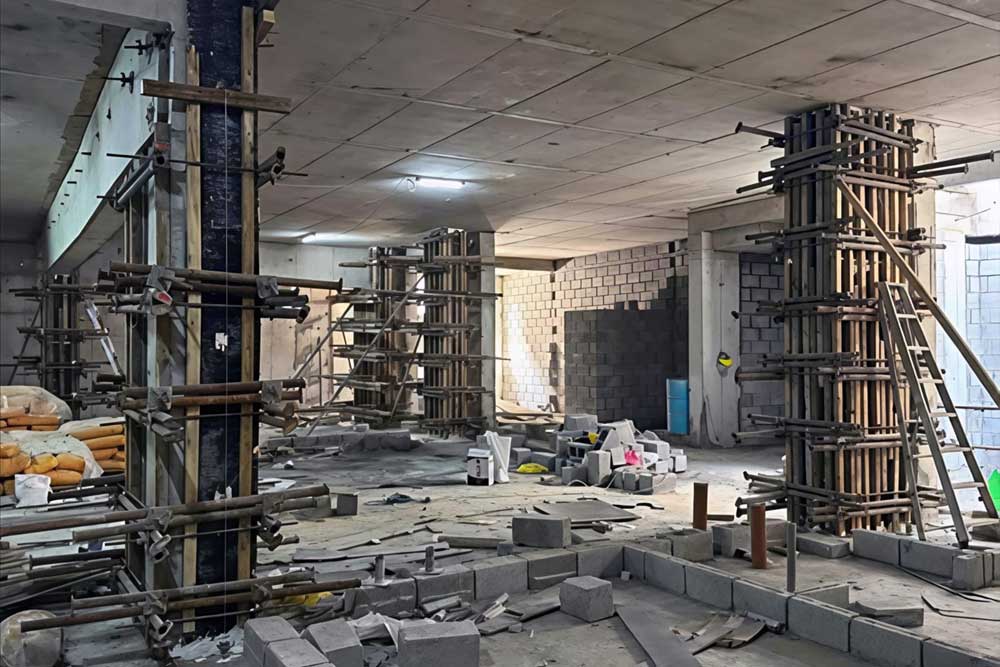
This involves wrapping concrete or steel around existing structural members to improve strength. It’s one of the most common methods, especially in aging residential and commercial buildings.
Seismic Retrofitting
To enhance earthquake resistance, buildings are often retrofitted with base isolators, shear walls, or braces that absorb seismic energy. Given Delhi NCR’s seismic vulnerability, this technique is critical.
Column and Beam Jacketing: Definition & Types
What is Jacketing?
Jacketing is a structural retrofitting technique used to strengthen or repair existing columns and beams by adding new material around them. The goal is to increase the load-carrying capacity, ductility, and overall structural performance of members that are damaged, deteriorated, or insufficient under new design requirements (earthquakes, additional floors, code upgrades, etc.).
Jacketing enhances:
• Axial and bending strength
• Shear resistance
• Confinement of concrete
• Stiffness and stability
1. Column Jacketing
What is Column Jacketing?
Column jacketing involves encasing an existing column with additional materials (concrete, steel, FRP, etc.) to improve its load capacity, repair damage, or increase ductility.
When is Column Jacketing used?
• To upgrade structures for seismic resistance
• To repair deteriorated or corroded columns
• To support additional floors or increased loads
• To improve inadequate reinforcement in old buildings
• To restore fire-damaged or poorly constructed members
2. Beam Jacketing
What is Beam Jacketing?
Beam jacketing is the process of strengthening beams by adding material around or along their sides or bottom to increase their flexural capacity, shear resistance, and stiffness.
Common reasons for Beam Jacketing:
• Cracks in beams due to overload or poor design
• Need for increased shear or flexural strength
• Corrosion of steel reinforcement
• Earthquake-related structural upgrade
• Support for changed usage or added floors
Types of Jacketing
Jacketing can be broadly classified into four major types:
1. Concrete Jacketing
Also called RC Jacketing.
What it involves
• Adding a new layer of reinforced concrete around the existing member
• Fixing new reinforcement with shear connectors/dowels
Advantages
• High strength and durability
• Improves axial, shear, and flexural capacity
• Enhances confinement
Disadvantages
• Increases size of member
• Adds weight to structure
• Requires significant site time and curing
Uses
• Earthquake strengthening
• Repairing damaged or corroded columns/beams
2. Steel Jacketing
Also called Steel Plate Jacketing or Encasement.
What it involves
• Wrapping the column or beam with steel plates/channels
• Plates are anchored using bolts, welding, or epoxy
• Can be filled with grout for better bonding
Advantages
• Very high tensile and shear strength
• Minimal increase in size
• Faster installation than concrete
Disadvantages
• Corrosion risk (needs protection)
• Skilled labor and fabrication required
Uses
• Urgent retrofits
• High-rise buildings
• Heavy load or seismic improvements
3. FRP Jacketing
(Fiber Reinforced Polymer using carbon, glass, or aramid fibers)
What it involves
• Bonding FRP sheets or wraps around the member using epoxy
• Provides confinement and increases flexural/shear capacity
Advantages
• Lightweight and corrosion resistant
• Minimal increase in dimensions
• Fast installation
• High strength-to-weight ratio
Disadvantages
• Higher material cost
• Sensitive to temperature and fire
• Requires surface preparation
Uses
• Seismic upgrades
• Strengthening beams for flexure/shear
• Rapid repair projects
4. Steel Fiber or Shotcrete Jacketing
Often used in repair of damaged members.
What it involves
• Using shotcrete (sprayed concrete) with steel fibers or mesh
• Adds reinforcement and repairs spalling
Advantages
• Good for irregular surfaces
• Faster application
• Increased toughness and crack resistance
Disadvantages
• Requires skilled workmen
• Proper bonding and curing critical
Comparison Table
Column & Beam Jacketing Methods
| Criteria | RC Jacketing | Steel Jacketing | FRP Jacketing | Shotcrete Jacketing |
| Size Increase | High | Medium | Minimal | Medium |
| Weight | High | Moderate | Low | Moderate |
| Strength Gain | Excellent | Excellent | High | Good |
| Cost | Medium–High | Medium | High | Medium |
| Install Speed | Slow | Fast | Very Fast | Medium |
| Durability | Very High | High | High | High |
