

10 Warning Signs Your Building Needs Repair & Rehabilitation Before It’s Too Late
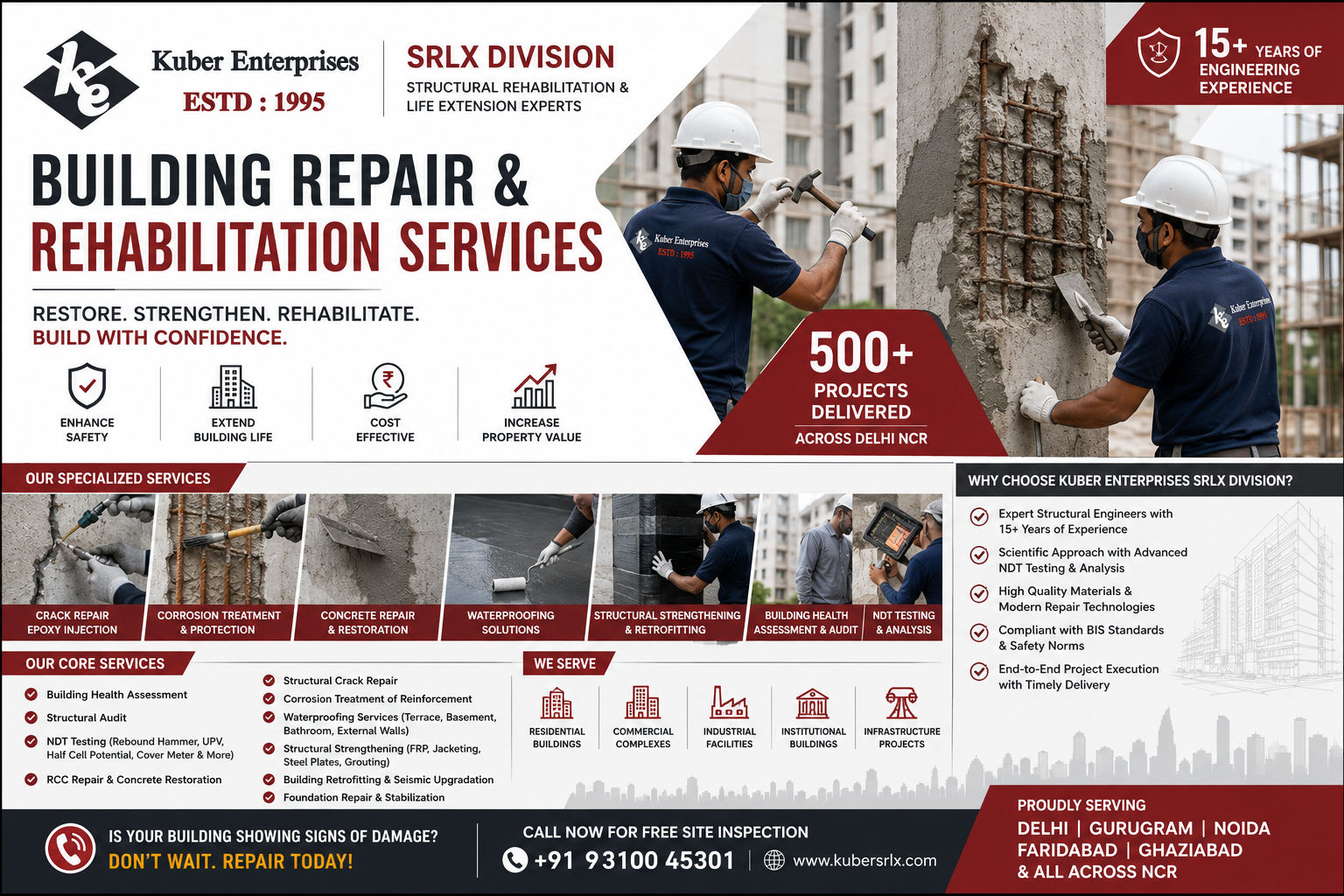
Building Repair & Rehabilitation is essential for maintaining the structural safety, durability, and long-term performance of residential, commercial, industrial, and institutional buildings. Over time, factors such as aging, water seepage, reinforcement corrosion, environmental pollution, and heavy usage can weaken a structure. Identifying these warning signs early and taking timely corrective action can prevent costly repairs, improve safety, and significantly extend the building’s lifespan. Kuber Enterprises SRLX Division provides expert Building Repair & Rehabilitation Services, including Structural Audit, Building Health Assessment, RCC Repair, Waterproofing, Structural Strengthening, and NDT Testing across India.At Kuber Enterprises, our SRLX Division specializes in professional Building Repair, Structural Rehabilitation, RCC Repair, Structural Audit, NDT Testing, Waterproofing, and Building Health Assessment services across India. Building Repair & Rehabilitation is essential for maintaining the structural safety, durability, and long-term performance of residential, commercial, industrial, and institutional buildings. Over time, factors such as aging, water seepage, reinforcement corrosion, environmental pollution, and heavy usage can weaken a structure. Identifying these warning signs early and taking timely corrective action can prevent costly repairs, improve safety, and significantly extend the building’s lifespan. Kuber Enterprises SRLX Division provides expert Building Repair & Rehabilitation Services, including Structural Audit, Building Health Assessment, RCC Repair, Waterproofing, Structural Strengthening, and NDT Testing across India.Our experienced structural engineers deliver safe, durable, and cost-effective rehabilitation solutions for residential, commercial, industrial, and institutional buildings.Buildings are among the most valuable assets we own, whether they are residential apartments, commercial complexes, industrial plants, hospitals, schools, or institutional facilities. However, every structure is exposed to environmental conditions, continuous usage, moisture, pollution, and natural aging, all of which gradually reduce its structural performance.
Many property owners assume that small cracks, damp walls, or minor concrete damage are cosmetic issues. In reality, these are often early indicators of deeper structural problems. Ignoring them can lead to expensive repairs, safety hazards, reduced property value, and even structural failure.
This is where professional Building Repair and Rehabilitation Services become essential. A qualified Building Repair Company not only repairs visible damage but also identifies the root cause of deterioration and restores the overall health of the structure.
At Kuber Enterprises SRLX Division, we specialize in comprehensive Structural Rehabilitation Services designed to restore, strengthen, and extend the life of buildings using modern engineering techniques, scientific investigations, and advanced repair materials.
With years of experience across residential, commercial, industrial, and infrastructure projects, our team delivers reliable solutions that improve structural safety while minimizing downtime and long-term maintenance costs.
What is Building Repair and Rehabilitation?
Kuber Enterprises SRLX Division follows a scientific engineering approach where every rehabilitation project begins with a detailed structural assessment before recommending the most effective repair methodology. Building Repair and Rehabilitation is a systematic engineering process that restores damaged or deteriorated structures to a safe, durable, and functional condition without the need for complete demolition.
Unlike temporary maintenance work, rehabilitation focuses on understanding the root cause of deterioration before implementing permanent corrective measures.
A professional Building Rehabilitation Company evaluates the entire structure using engineering analysis, Building Health Assessment, Structural Audit, and NDT Testing before recommending the most suitable repair strategy.
Depending on the condition of the structure, rehabilitation may include:
- Structural Crack Repair
- RCC Repair
- Concrete Repair Services
- Structural Strengthening
- Waterproofing Services
- Foundation Repair
- Corrosion Protection
- Building Retrofitting
- Seismic Upgradation
- Concrete Restoration
The objective is not only to repair existing damage but also to prevent future deterioration and significantly extend the service life of the building.
Repair vs Rehabilitation – Understanding the Difference
Many people use the terms “repair” and “rehabilitation” interchangeably, but they are technically different.
Building Repair
Building repair addresses a specific defect or localized damage. Examples include repairing a crack, replacing damaged concrete, or stopping a water leak.
Repair focuses on fixing the visible problem.
Building Rehabilitation
Rehabilitation is a comprehensive engineering approach that restores the structural integrity of the entire building. It involves investigating why the damage occurred, assessing the condition of all structural components, and implementing long-term solutions.
A professional Structural Repair Company examines the complete structure before recommending repairs, ensuring that the root cause is eliminated rather than simply treating the symptoms.
For example, if a beam develops cracks because of reinforcement corrosion, simply filling the cracks will not solve the problem. The deteriorated concrete must be removed, corroded reinforcement treated, the section restored using Concrete Repair Services, and appropriate corrosion protection measures applied.
This scientific approach ensures long-lasting structural performance and improved safety.
Why Do Buildings Deteriorate?
Every building has a designed service life, but several factors can accelerate deterioration if proper maintenance is neglected.
1. Natural Aging
Concrete, steel, waterproofing systems, and finishing materials naturally degrade over time. Older buildings require periodic inspections and timely rehabilitation to maintain safety.
2. Water Seepage
Water is the biggest enemy of reinforced concrete structures.
Continuous moisture causes:
- Reinforcement corrosion
- Concrete cracking
- Damp walls
- Mold growth
- Reduced structural strength
Professional Waterproofing Services play a critical role in protecting buildings from long-term damage.
3. Reinforcement Corrosion
When water and oxygen reach the steel reinforcement inside concrete, corrosion begins.
Rust occupies more volume than steel, creating internal pressure that leads to:
- Concrete cracks
- Concrete spalling
- Exposed reinforcement
- Reduced load-carrying capacity
Timely RCC Repair and corrosion treatment can prevent major structural failures.
4. Poor Construction Quality
Buildings constructed using inferior materials, inadequate curing practices, or poor workmanship often develop structural issues much earlier than expected.
A detailed Building Health Assessment helps identify these hidden deficiencies before they become critical.
5. Overloading
Many buildings are modified years after construction.
Examples include:
- Additional floors
- Heavy machinery
- Water tanks
- Solar installations
- Office conversions
These changes increase structural loads beyond the original design capacity.
A professional Structural Audit is essential before any major modification.
6. Environmental Pollution
Delhi NCR experiences:
- High pollution
- Carbonation
- Temperature variations
- Humidity
- Acidic rainwater
These environmental factors accelerate concrete deterioration and reinforcement corrosion.
Professional Structural Rehabilitation Services help buildings withstand these harsh environmental conditions.
7. Earthquakes
Many older buildings were not designed according to modern seismic standards.
A qualified Building Retrofitting Company can improve earthquake resistance through advanced Structural Strengthening techniques such as:
- Column Jacketing
- FRP Wrapping
- Steel Plate Bonding
- Beam Strengthening
- Shear Wall Installation
Retrofitting significantly improves structural safety and extends building life.
Why Early Intervention Saves Money
By partnering with Kuber Enterprises SRLX Division, property owners can identify structural defects at an early stage and implement cost-effective repair solutions before damage becomes severe. Our engineering team combines Building Health Assessment, Structural Audit, NDT Testing, RCC Repair, Concrete Repair, Waterproofing, Structural Strengthening, and Building Retrofitting to deliver durable rehabilitation solutions that increase the safety and lifespan of your structure.Ignoring early warning signs often results in:
- Higher repair costs
- Structural instability
- Reduced building lifespan
- Business interruptions
- Safety risks
- Lower property value
- Expensive emergency repairs
By partnering with an experienced Building Repair Company, property owners can identify defects early, implement cost-effective repairs, and avoid major structural failures in the future.
At Kuber Enterprises SRLX Division, our engineering-first approach combines Building Health Assessment, Structural Audit, NDT Testing, Concrete Repair Services, RCC Repair, Waterproofing Services, and Structural Strengthening to deliver durable, long-lasting rehabilitation solutions tailored to each building’s unique requirements.
10 Warning Signs Your Building Needs Repair & Rehabilitation Before It’s Too Late
1. Cracks in Walls, Columns, and Beams
One of the earliest indicators that a building requires professional attention is the appearance of cracks. While small hairline cracks caused by plaster shrinkage are usually not serious, wider cracks or those that continue to grow may indicate structural distress.
Cracks can develop due to foundation settlement, overloading, reinforcement corrosion, thermal expansion, seismic activity, or poor construction practices. If ignored, they may reduce the load-bearing capacity of the structure and eventually lead to costly repairs.
A qualified Structural Repair Company performs a detailed investigation to determine whether the cracks are cosmetic or structural. Based on the findings, appropriate repair methods such as epoxy injection, polyurethane grouting, stitching, or structural strengthening are recommended.
2. Water Seepage and Dampness
Persistent water leakage from roofs, terraces, balconies, basements, bathrooms, or external walls is one of the leading causes of structural deterioration.
Moisture entering reinforced concrete gradually corrodes the steel reinforcement, weakens concrete, and encourages fungal and mold growth. Dampness also damages paint, plaster, flooring, and electrical systems.
Professional Waterproofing Services combined with Concrete Repair Services permanently solve seepage issues instead of providing temporary fixes.
At Kuber Enterprises SRLX Division, waterproofing is integrated with rehabilitation to ensure long-term protection against water ingress.
3. Concrete Spalling
Concrete spalling occurs when pieces of concrete start breaking or falling from slabs, beams, balconies, columns, or ceilings.
Common reasons include:
- Reinforcement corrosion
- Carbonation
- Water penetration
- Freeze-thaw effects
- Poor concrete quality
Spalling exposes steel reinforcement to the atmosphere, accelerating corrosion and weakening the structure.
A professional Building Repair Company removes the damaged concrete, treats corroded reinforcement, and restores the section using high-performance repair mortars and micro-concrete systems.
4. Rust Stains and Exposed Reinforcement
Brown rust stains on walls or ceilings often indicate hidden reinforcement corrosion.
When steel bars corrode, they expand and crack the surrounding concrete, eventually exposing the reinforcement.
Ignoring exposed reinforcement can significantly reduce the structural capacity of beams, slabs, and columns.
Professional RCC Repair includes:
- Rust removal
- Anti-corrosion treatment
- Steel replacement (if required)
- Concrete reinstatement
- Protective coatings
Timely intervention helps extend the life of the structure while avoiding expensive reconstruction.
5. Uneven Floors and Foundation Settlement
If you notice uneven flooring, sloping surfaces, or doors and windows that no longer close properly, your building may be experiencing foundation settlement.
Settlement can occur because of:
- Weak soil conditions
- Water table fluctuations
- Poor compaction
- Additional structural loads
A comprehensive Building Health Assessment helps identify whether the movement is active or stabilized. Engineers then recommend suitable foundation stabilization or structural strengthening techniques.
6. Excessive Deflection in Slabs or Beams
Floors that feel bouncy or beams that visibly sag may indicate excessive deflection.
Possible reasons include:
- Increased loading
- Concrete deterioration
- Reinforcement corrosion
- Design deficiencies
These conditions require immediate attention from an experienced Structural Repair Company.
Modern Structural Strengthening solutions such as FRP wrapping, steel plate bonding, or beam jacketing can restore load-carrying capacity.
7. Aging Buildings
Buildings older than 20–30 years should undergo periodic inspections, even if no obvious damage is visible.
Concrete naturally deteriorates due to:
- Carbonation
- Chloride attack
- Environmental pollution
- Thermal movement
- Moisture penetration
A professional Building Rehabilitation Company recommends preventive maintenance programs that increase durability and reduce lifecycle costs.
Routine inspections help identify hidden defects before they become major structural problems.
8. Structural Modifications Without Engineering Review
Many property owners modify existing buildings by:
- Adding extra floors
- Removing walls
- Installing heavy equipment
- Expanding commercial spaces
- Converting residential buildings into offices
Such modifications alter the original structural load distribution.
Before making any structural changes, a detailed Structural Audit should be carried out to verify whether the building can safely support the additional loads.
9. Earthquake Damage or Seismic Deficiency
Buildings located in seismic zones should be evaluated periodically for earthquake resistance.
Older buildings often do not comply with modern seismic design standards.
A specialized Building Retrofitting Company upgrades structural performance using advanced strengthening techniques, including:
- RCC jacketing
- Steel jacketing
- FRP wrapping
- Shear wall construction
- Beam-column joint strengthening
- Foundation strengthening
These measures improve occupant safety and significantly reduce earthquake-related risks.
10. Frequent Maintenance Problems
If your building requires repeated repairs every few months, the underlying structural issues may not have been properly addressed.
Repeated patchwork solutions often waste money because they treat symptoms rather than the root cause.
An experienced Building Repair Company first identifies the source of deterioration before implementing permanent rehabilitation solutions.
Scientific diagnosis always provides better long-term results than temporary maintenance.
Why Building Health Assessment is Essential
Before beginning any repair work, engineers must understand the actual condition of the structure.
A Building Health Assessment is a systematic engineering evaluation that identifies hidden defects, assesses structural performance, and recommends suitable rehabilitation measures.
The assessment generally includes:
- Visual structural inspection
- Crack mapping
- Reinforcement corrosion analysis
- Concrete condition evaluation
- Structural stability review
- Material testing
- Load assessment
- Foundation evaluation
This comprehensive approach ensures that repair work is technically sound and cost-effective.
Importance of Structural Audit
A Structural Audit is one of the most important preventive maintenance tools for existing buildings.
It helps determine:
- Current structural condition
- Safety level
- Remaining service life
- Repair priorities
- Rehabilitation requirements
- Future maintenance planning
Residential societies, commercial buildings, hospitals, schools, factories, and government structures should undergo periodic structural audits to ensure public safety and regulatory compliance.
Role of NDT Testing in Structural Rehabilitation
Modern rehabilitation projects rely heavily on NDT Testing (Non-Destructive Testing) because it allows engineers to evaluate structural health without damaging the building.
Common NDT methods include:
- Rebound Hammer Test – Measures the surface hardness and approximate compressive strength of concrete.
- Ultrasonic Pulse Velocity (UPV) Test – Detects internal cracks, voids, and concrete quality.
- Cover Meter Survey – Determines the location and depth of reinforcement bars.
- Half-Cell Potential Test – Assesses the probability of reinforcement corrosion.
- Carbonation Test – Measures carbonation depth and evaluates corrosion risk.
- Core Testing (where required) – Confirms the in-situ strength of concrete.
Using the results of these tests, engineers can prepare an accurate rehabilitation strategy instead of relying on assumptions. This scientific approach reduces unnecessary repair costs and ensures long-term structural performance.
Why Choose Kuber Enterprises?
Whether your building has cracks, seepage, corrosion, foundation settlement, or structural deterioration, Kuber Enterprises SRLX Division provides end-to-end Building Repair and Rehabilitation Services backed by experienced structural engineers, advanced NDT Testing, Structural Audit, and modern rehabilitation technologies.
Our Services Include:
- Building Health Assessment
- Structural Audit
- NDT Testing
- RCC Repair
- Concrete Repair
- Structural Strengthening
- Waterproofing
- Building Retrofitting
- Corrosion Protection
📞 Contact Kuber Enterprises today for a professional structural inspection and ensure the long-term safety, durability, and performance of your building.